Dark Matter · Research & Development

The infrastructure your firm needs
but can't buy.

Custom quantitative software, machine-learning models, and data infrastructure for financial firms. Built end to end, on your data, in your environment, with the source owned outright by you. For the workflows vendor platforms can't reach and the bespoke edges pure consulting won't ship.

Proven on
A live trading desk / production, daily
Engagement
Principal-led / end to end, no juniors
Delivery
Milestone-gated / weeks, not quarters
Ownership
Yours outright / source, data, infrastructure
Which best describes your firm?
01 /The Problem

Bespoke workflows. Custom data. The systems vendor platforms can't reach.

Every serious financial firm carries the same gap, from a single family office to a multi billion dollar asset manager, from an accounting practice to an insurer: workflows too specific for off the shelf platforms and edges too proprietary to hand to a consultancy. Custom data layers across custodians, prime brokers, and fund admins. Diligence that demands forensic depth on every deal. Monitoring infrastructure tailored to the actual mandate. Internal tools the firm runs on but never had time to build properly.

The work is automatable. Building it properly means standing up a dedicated quantitative engineering function: a senior hire, a manager, and a stack that has to be supported in perpetuity. Most firms don't carry that weight, so the work stays manual and the firm's best people spend their weeks rekeying data instead of making decisions.

$1.4T
in asset-manager IT spend industry-wide, and the bespoke layer keeps growing, not shrinking
~70%
of asset managers cite tech debt and system integration as their top operational blocker
57%
of family offices cite a lack of internal technology expertise as their #1 barrier
Months
a single mandate, direct deal, or fund launch can absorb without dedicated infrastructure
Sources: Citi Private Bank Global Family Office Report 2025 · UBS Global Family Office Report 2024 · Deloitte / EY industry surveys, 2024.
02 /What We Build

Bespoke systems, scoped to the workflows that matter most.

01

Diligence systems

Read an entire data room, verify management's claims against the source documents, and surface what matters, with a citation to every page, so it stands up to your investment committee. Months of work, compressed into days.

02

Data consolidation & reporting

Pull holdings across every custodian, bank, and asset class into one verified view. Automated reporting that turns a multi-day manual process into minutes, and gives you the clean data layer your models actually need.

03

Research & monitoring infrastructure

Live engines that aggregate market, portfolio, and on-chain data into a single source of truth, with an analytical layer that answers questions instead of making you dig through tabs.

04

Custom builds

If it's financial, document-heavy, and done by hand today, it can be built. Scoped to your exact workflow. Not a generic platform you bend to fit.

One system, four modules. Not a menu of hourly work.

Diligence & forensics
  • Full data-room ingestion (PDFs, decks, 10-Ks) → structured
  • Claims-vs-data cross-check, cited to source page
  • Beneish M, Altman Z, Piotroski F forensic suite
  • Management-memo verification & red-flag triage
  • Committee-ready memo output, one click
Reporting & data layer
  • Multi-custodian holdings consolidation (cash to derivatives)
  • Statement / K-1 / capital-call PDF → structured data
  • Position & performance reporting, scheduled or on demand
  • Reconciliation against custodian and bank feeds
  • Clean, AI-ready data layer the whole firm can query
Research & monitoring
  • Live market-data pipelines (equities, crypto, macro, energy)
  • 13F intelligence and ownership-change alerts
  • 18-method intrinsic-value ensemble
  • Machine-learning signal & forecasting models
  • Conversational analytical layer over your data
Execution & ops
  • Backtesting and signal infrastructure (tick-level if needed)
  • Order management, execution analytics, slippage attribution
  • Risk dashboards: exposure, concentration, scenario
  • Internal workflow automation across front / middle / back
  • Investor-relations reporting and audit-grade trails
  • Provenance and governed access: every output cited, every run logged
Every item above is something we already operate inside the Dark Matter Terminal. We don't research the problem. We adapt the solution.
03 /Compliance & Control

The layer the CIO doesn't buy and the COO can't run without.

Two buyers, one system. Your investment side buys research, data, and diligence. Your operating side, the COO, the compliance officer, the controller, buys the reporting and control layer underneath it. This is that layer, built to the standard your auditor and your examiner will hold it to.

Lead capability

Compliance & reporting automation

The reporting and compliance layer that removes the operational overhead constraining your mandate. Risk and regulatory reports generated in your required format, reconciled against every feed, with a full audit trail on every number. What takes a team a week, produced on schedule, unattended.

  • Regulatory report generation in required formats (risk, exposure, concentration, limits monitoring)
  • Automated reconciliation against custodian, prime-broker, and fund-admin feeds
  • Audit-grade trails on every figure, source-traceable to the document
  • Investor / LP reporting, capital-account statements, capital-call and K-1 handling
Paired capability

Governance & provenance

Every output traces to the document it came from. Every run is logged with a full audit trail. Identity, permissions, and approved sources enforced in one place: built to stand up to your compliance officer, your auditor, and an examiner.

  • Every figure cited to its underlying document or data point
  • Full run logging and audit trail on every job
  • Identity, permissions, and approved sources enforced centrally
  • Built for review by compliance, audit, and the regulator

What the overhead costs, and what automating it gives back.

60–70%
of regulatory-reporting cost is staff time, not systems. The manual work is the expense.
15–25%
of analyst hours automation removes from low-value reporting and reconciliation work
20–35%
cut in reporting and reconciliation labor cost once the layer runs unattended
80%
fewer manual steps in a live asset-manager reconciliation deployment
Sources: Deloitte and industry regulatory-reporting analyses · LexisNexis True Cost of Compliance · finance-automation ROI and asset-manager reconciliation deployments, 2023–2025.
◆ Confidentiality & data
Mutual NDA before any engagement. It runs in your environment, under your controls. We never hold or move your data. Source, infrastructure, and data are yours outright.
NDA first

Mutual NDA signed before the scoping sprint begins.

Your environment

AWS, Azure, GCP, or on-prem. Your account, your VPC, your controls.

Your data stays put

We never custody, host, or move your data into a vendor cloud.

Owned outright

Source code, infrastructure, and data are yours. No lock-in.

04 /Proof

We built this to run our own fund.

We run a systematic, market-neutral fund. To operate it, we built the Dark Matter Terminal. A live market-intelligence system spanning forensic accounting, an 18-method valuation ensemble, a live 13F reader, dark-pool tagging, and AIS shipping-flow tracking, fronted by a conversational analytical layer (with voice) that reads every engine and answers any market question with cited, evidence-based research.

Built end to end, in-house. This isn't a slide deck. It's production infrastructure the fund trades on every day. Most firms describe systems like this in a five-year plan. We run ours daily, and it's the proof of what we'll build for you.

Conversational analytical layer · a live market question, answered with cited confluence
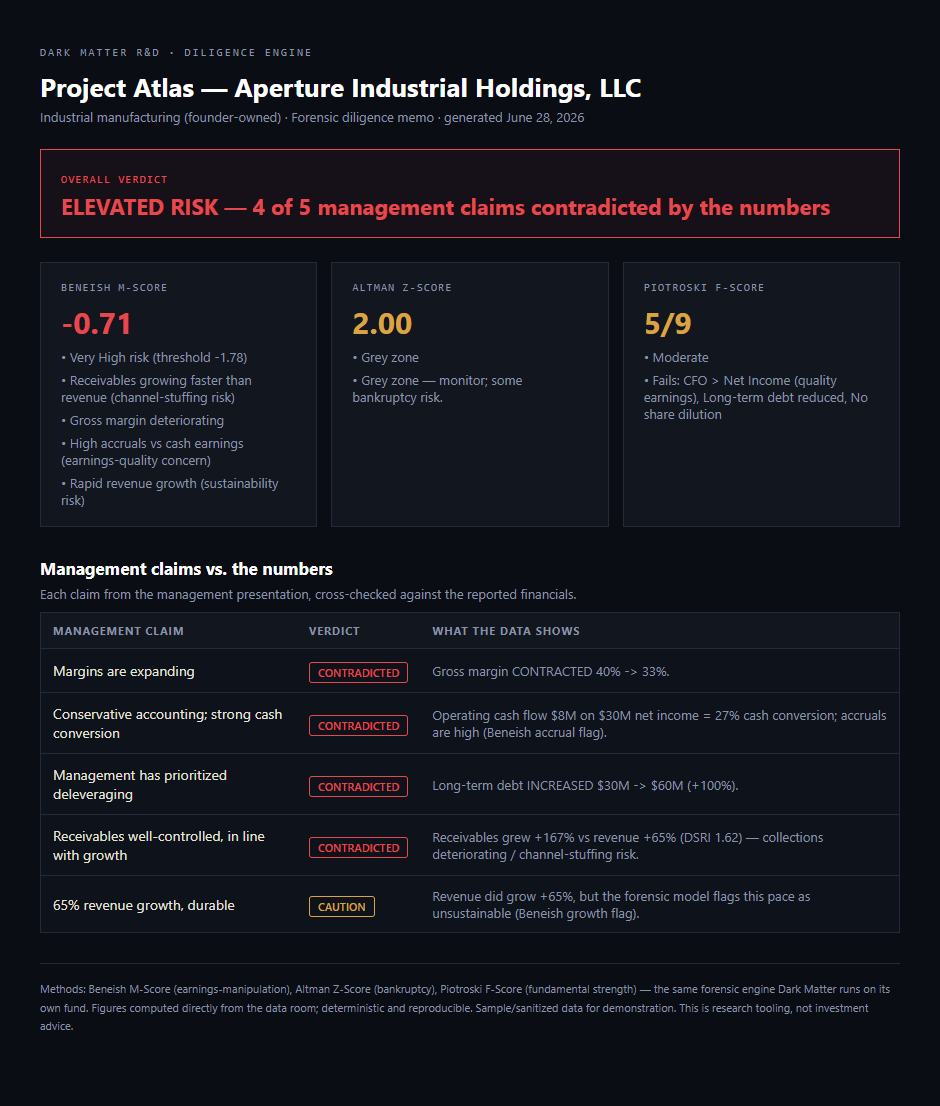
Diligence Engine: an ELEVATED RISK forensic memo, 4 of 5 management claims contradicted by the numbers, with Beneish M, Altman Z and Piotroski F scorecards
Diligence Engine · forensic memo, run on a sample data room
05 /How It Works

Scoped, staged, and risk-reversed.

01
Fixed-fee

Scoping sprint

A fixed-fee sprint to spec your exact workflow, data sources, and the build, with a working prototype on your real data. Fully credited toward the build if you proceed, and if the spec isn't right, you walk with the work and owe nothing further. You know precisely what you're getting before you commit.

02
Milestone-gated

Milestone build

Delivered in stages tied to working deliverables on your data. You don't pay past any milestone unless it's delivering exactly what was promised. Code review with your CTO, external auditor, or trusted advisor is welcomed. Encouraged, actually.

03
You own it

Live & maintained

It runs in your environment. Your data, your controls, full audit trail. Source code, infrastructure, and data are yours outright: no black box, no lock-in, no ransom on year two. Ongoing maintenance and iteration keep it sharp as your needs evolve.

Loaded cost of building it in-house$900k–$1.6M / yra realistic team for this work: senior quant developer + senior data engineer + ops engineer, fully loaded (base, bonus, benefits, payroll taxes, equipment, management overhead). A single senior quant developer alone runs $450k to $800k loaded.
A scoped build, end to endFraction of one FTE / oncedelivered in weeks, fully owned by you afterward, runs without supervision. The same outcome a multi-year in-house buildout would produce, without the recruiting cycle or the multi-year ramp.

What you walk away with

Working system in your environment Full source code in your repo Integration tested against your live data Architecture & runbook documentation Training session for your team Mutual NDA + audit trail
◆ Validation

Before anything ships, it is tested to break.

The same adversarial process that has killed more of my own strategies than it has kept, turned on your models, your backtests, your assumptions. What survives is what you deploy. Nothing reaches your book on trust alone.

06 /Engagements

Three ways to work together.

01
Project

Build

Custom systems delivered end to end, on your data, the source owned outright. Scoped by a fixed-fee sprint and delivered milestone by milestone.

02
Retained

Embedded principal

Fractional quant engineering for a CIO or PM: architecture, vendor assessment, technical review, and hands-on build. The capability of a senior hire, without the headcount.

03
Cohort

Training

Bring your analysts up on the systems and methods, taught from the same practitioner stack a live fund runs on. Hands-on or cohort-based.

07 /vs The Alternatives

Stack us against what your firm would otherwise do.

A sceptical buyer's mental matrix, drawn explicitly. Pick the column that fits.

Off-the-shelf platforms
(enterprise wealth-tech, AUM-priced)
Big consulting
(global firms & systems integrators)
In-house hire
(quant dev + data eng + ops eng)
Dark Matter R&D
Custom build, you own it
Cost
~$75k–$300k+/yr, AUM-based, recurring forever
$500k–$5M+ per engagement, partner-rate
$450k–$800k/yr per senior quant eng; team of 3 ≈ $900k–$1.6M/yr
Scoped to the build. A fraction of any of these, then it's yours
Fit to your workflow
Generic. You bend to it
Custom, but slide-heavy
Custom, if they stay
Custom. Scoped to you, on your data
Time to value
Months of onboarding
6–18 months
6–12 months to hire, then ramp
Weeks, milestone-gated
Who builds it
Vendor PM + global support
Team of juniors, partner sells
Whoever you can hire
A fund operator. End to end.
Ownership
Vendor lock-in, your data on their cloud
Deliverables + ongoing dependency
Yours, and the key-person risk
Source & data fully yours, in your environment
What happens year 2
Renewal invoice
Statement of work #2
Salary + benefits + bonus
It keeps running. Optional retainer if you want changes.
With

Every claim in the memo cites the filing it came from.

Without

An analyst's spreadsheet nobody can audit six months later.

With

The system runs in your environment, every action logged.

Without

Firm data sitting in a vendor's cloud you can't inspect.

Platform figures are third-party estimates: enterprise wealth-tech platforms typically price on assets under management and do not publish rates. Consulting and in-house figures are typical loaded costs, not quotes. Comparison is illustrative, for reference only.
08 /Why Us

A fund desk that builds. Not an agency that read about finance.

We run what we build

We operate a live trading desk. We know what investment-grade output looks like, where the integration debt actually accumulates, and what survives an IC, an auditor, and a Monday open. Because we ship to ourselves every day.

One principal, end to end

The person scoping your build is the one writing the code, integrating your data, and standing behind it. No juniors on your account, no account-manager game of telephone, no offshoring.

Committee-ready by design

Source-traceable output with citations to the underlying documents. Built to stand up to an IC, an auditor, and a sceptical principal. Not to impress in a demo.

Your data, your environment

It runs under your controls with a full audit trail. You own the source code, the data, and the infrastructure outright. No black box, no lock-in, no positions touched.

09 /Who Builds It

You work directly with the person who built it.

Ryan Germain, Founder of Dark Matter R&D
Ryan Germain
Founder & Principal Engineer

I run Dark Matter, a systematic, market-neutral digital-asset fund, and built the market-intelligence system it trades on: data pipelines, research and forensic engines, execution, and a conversational analytical layer that answers any market question with cited, evidence-based research.

Through Dark Matter Research & Development, I build systems of that caliber for other firms, on their data, in their environment. The work is quantitative and engineering in equal measure, full-stack and end to end: research, reporting and compliance automation, data infrastructure, execution and validation.

What sets it apart is straightforward. It runs against a live book every session, so it has to hold up in a real market rather than a demo. If your team is doing by hand what well-built infrastructure should handle, I would welcome the conversation.

10 /Frequently Asked

Anticipating the obvious questions.

If your IC, CTO, or compliance officer would ask it, it's probably below.

Where does our data live?

Your environment. AWS, Azure, GCP, on-prem. Your account, your VPC, your controls. We never hold or move your data into a vendor cloud. Mutual NDA on every engagement, signed before the scoping sprint.

What if you get hit by a bus?

You have the full source code and documentation in your repo from day one. A qualified engineer can pick up where I left off without me. No black-box hosting, no proprietary runtime, no lock-in.

Do we need a CTO to maintain it?

No. The system runs unattended. For changes or extensions, you can either retain me at a flat monthly rate, hand it to your team, or hire a freelance engineer. Your call. Most clients pick the retainer because it's cheaper than one developer day.

Why not just buy an off-the-shelf platform?

Because off-the-shelf platforms force your workflow to fit their schema, charge you in perpetuity, and don't extend to the messy edges (your bespoke statements, your custom diligence, your specific monitoring). If a platform fits, use it. If it doesn't, the manual work isn't going away, and that's where I come in.

How is this not just another "AI consultant"?

I'm not packaging a generic LLM behind a chatbot. The Terminal, and what I'd build for you, is purpose-built infrastructure where AI is one layer over a deterministic, source-traceable engine. Every claim cites the underlying document or data point. The output stands up to an investment committee.

What's the typical engagement size?

Scoping sprints are fixed-fee and fully credited to the build. Builds scope from focused single-workflow systems through full data-layer rollouts and multi-system, enterprise-scale infrastructure. The scoping sprint produces a written spec with a fixed quote on the build. You decide on a known number, not an open meter.

What language and stack?

Python is the workhorse for data, machine-learning, and quantitative work; C++ / Rust appear in performance-critical paths (execution, tick-level signals); TypeScript / React for any UI. We pick the tool that fits the job, not the other way around, and every choice is documented so your team or a successor can read the code.

Will you sign our paper?

Yes. Mutual NDAs, MSAs, your DPA. I'm comfortable with code review by your CTO, an external auditor, or a trusted technical advisor. I'd rather you verify it than take my word for it.
◆ Engagements we'd decline
  • Anything that requires us to hold, custody, or trade your assets
  • "Build us an AI hedge fund from a YouTube tutorial"
  • Generic CRM, HR, or marketing automation outside finance
  • Greenfield SaaS MVPs unrelated to the buyer's existing book
  • Pure advisory or PowerPoint engagements without a shipped artifact
  • Anything we wouldn't ship to ourselves
Start a Conversation

Where vendor platforms end,
we begin.

Bring one process. The one your best people lose a day a week to, that everyone agrees should be automated and never is: the reconciliation, the diligence read, the reporting pack, the data pull nobody trusts. Tell me what it is, what it currently costs you in hours, and where it breaks.

You get a working diagnostic in return: whether it should be built, what it would take, and where the hard parts actually are. If the honest answer is that a platform already does this well, I will tell you that instead. Substantive and direct. No slide deck.

Engagements taken selectively. Principal-led, in sequence, on the work that matters
Runs in your environment Ownership source & data are yours Audit full trail, committee-ready Delivery milestone-gated
Prefer to write?  ·  ryan@darkmatter.financial
◆ Start a build
Book a working callBring the workflow. We confirm within the day
or send a brief

GOES STRAIGHT TO US · WE REPLY WITHIN A DAY